

The Buso dei Briganti and Cava Bomba are two emblematic places of the Euganean Hills, rich in history, legends, and natural beauty.
Buso dei Briganti
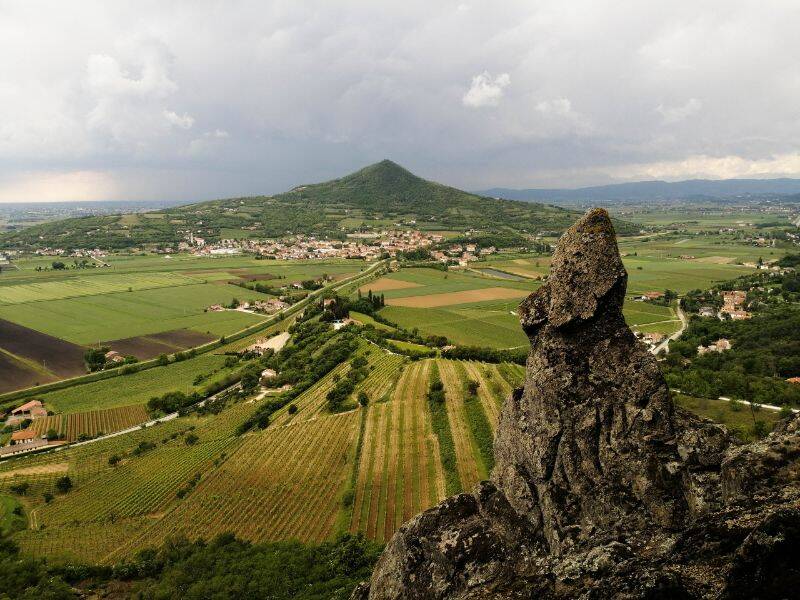
Located on Mount Cinto, the Buso dei Briganti is a rock formation that owes its name to the legends related to the brigandage of the nineteenth century. It is said that the brigands used this place as a hiding place to monitor and attack travelers. The Radetsky decree of 1849 punished the carrying of weapons and their possession with the death penalty. This decree caused the phenomenon of brigandage to grow, spreading in the mid-nineteenth century. According to the historian Paul Ginsborg, a gang of about 30 people found shelter among the inaccessible rocks of Mount Cinto, protected by the parish priest of Torreglia and led by Antonio Magagnin, a deserter from the Austrian army. A large hole in the shape of a door, called “The Door of the Brigands” where the mark of the door that closed the access is still clearly visible, opens halfway up on a natural trachyte terrace overlooking the plain below. From here, the brigands controlled the valley and signaled the presence of people or carriages. In the center of the castle ruins, an ancient mortar is clearly visible, probably also used at the time of the brigands for the production of gunpowder. Today "The Door of the Brigands" is an evocative panoramic point, reachable via a path well-equipped with ladders and handrails.
Cava Bomba
Cava Bomba, on the other hand, is a former limestone quarry converted into a geo-paleontological museum. Here it is possible to observe the rocky layers that tell the geological history of Mount Cinto, with volcanic formations such as the rhyolite columns, the result of the cooling of lava. The name is due to the presence of a spring located near the complex, called precisely 'Bomba', whose water was pumped for industrial needs. The industrial plant of Cava Bomba was a kiln for the production of quicklime, supplied by the precious limestone from the quarry on Mount Cinto next to large cooking vats. The quarry is also known for fossil findings of tropical fish dating back 92 million years. The museum offers an interesting testimony of the extractive activity and the environmental recovery of disused quarries. In fact, the limestone rocks, after being extracted with small explosive charges, were transported to the kilns first by carts pulled by mules and later by small wagons pushed along the tracks of a small decauville railway, whose path has been partly reconstructed. Through the walkways, the limestone was discharged into the mouths of the kilns to be cooked: thus began the production of lime in lumps. Since the nineteenth century, the extraction of volcanic stone (rhyolite and trachyte) allowed its use in construction, architecture, and the paving of streets and squares such as San Marco in Venice.
Hiking Route
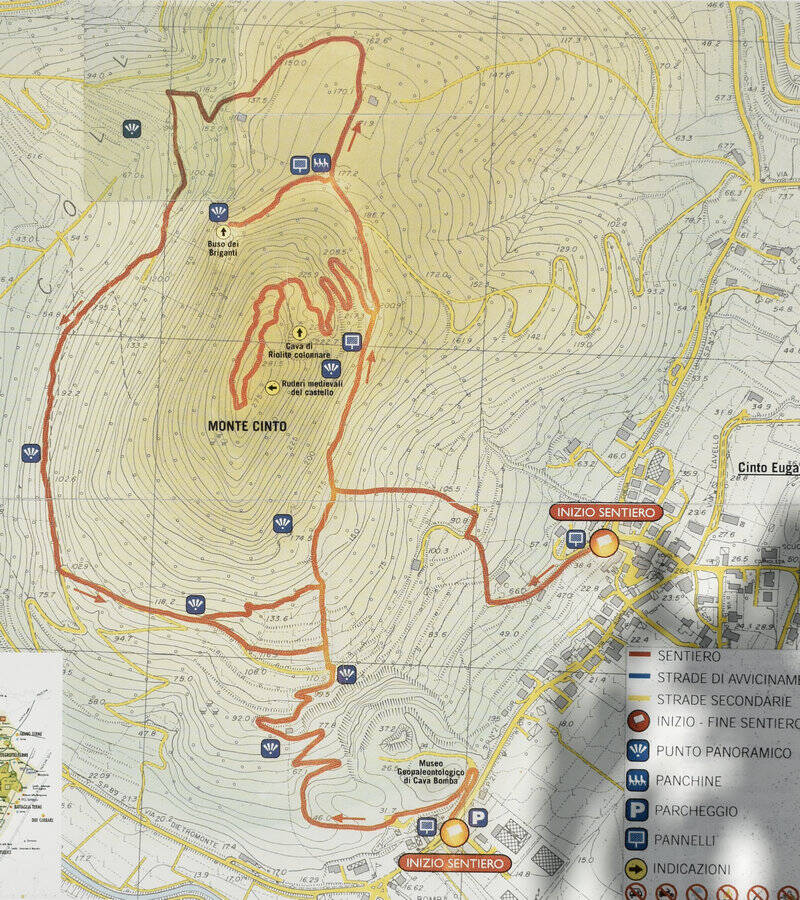
A hiking route of about 6 km connects Cava Bomba to the Buso dei Briganti, passing over the summit of Mount Cinto.
-
Geo-paleontological Museum of Cava Bomba: Start your excursion with a visit to the museum, which offers an overview of the geological history of the Euganean Hills, with fossils and volcanic finds. It is an excellent introduction to the natural context of the route.
-
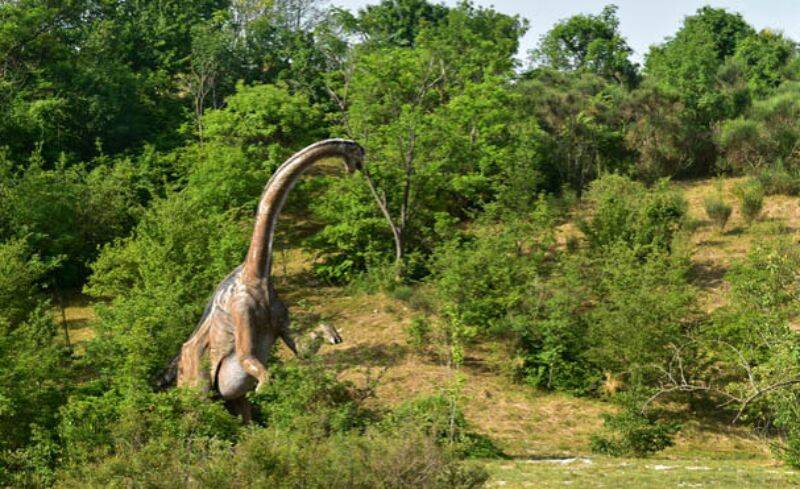
Geological Park of Cava Bomba: Continue towards the geological park, where you will find reproductions of dinosaurs and informative panels on the volcanic formation of the hills. This stretch is also suitable for children and offers an educational experience.
-
Rhyolite Quarry: Head towards the rhyolite quarry, famous for its lava columns, the result of the cooling of lava. This site is a spectacular example of the volcanic geology of the area.
-
Mount Cinto: Reach the summit of Mount Cinto (281 m), although partially covered by vegetation, it offers a panoramic viewpoint of the Euganean Hills and the surrounding plain.
-
Buso dei Briganti: Descend towards the Buso dei Briganti, a rock formation with a history linked to brigandage. Here you will find a breathtaking viewpoint with 360° views of the Euganean and Berici Hills. The path is equipped with ladders and handrails, making it accessible even to the less experienced.
-
Pianoro delle Masagne: Add a stop at the Pianoro delle Masagne, an area with picnic tables and a vast lawn, ideal for a refreshing break before resuming the route.
-
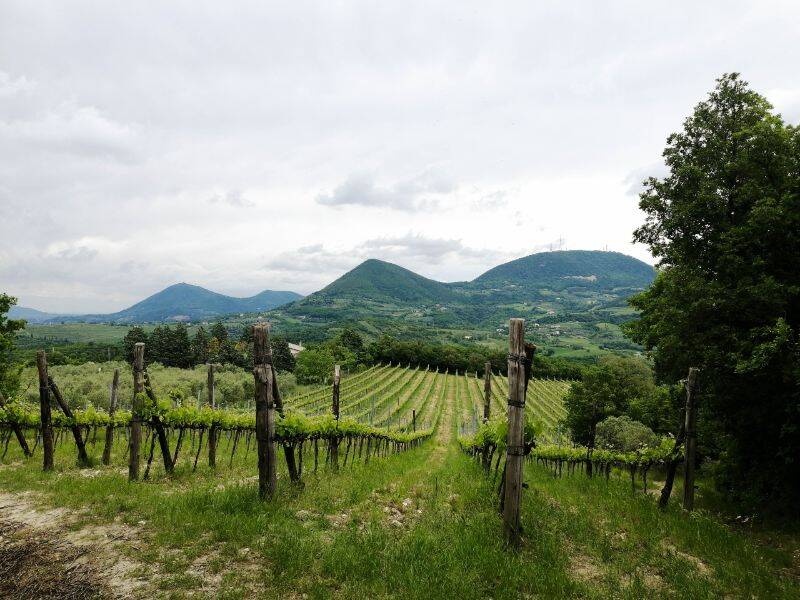
Vineyard Path: Conclude the route crossing the terraced vineyards of the southern slope of Mount Cinto, where you can admire olive trees and typical agricultural landscapes of the area.
Technical Details
-
Length: About 7 km (extendable up to 10 km with additional stops).
-
Elevation gain: 300 m.
-
Difficulty: Medium, suitable for hikers with a minimum of experience.
-
Travel time: 3-4 hours, depending on stops and added stages.
Tips
-
Bring water and a snack, especially if you intend to stop at the Pianoro delle Masagne.
-
Wear trekking shoes and suitable clothing, as some sections are rocky.
-
Check the path conditions, particularly for possible rock detachments.
This extended route offers a combination of history, geology, and breathtaking landscapes, making it a complete and unforgettable experience in the Euganean Hills.
Conclusions:
For those who want a comfortable and strategic stay after exploring Cava Bomba and the Buso dei Briganti, Casa Luna in Montegrotto Terme is an excellent choice.
FAQ:
-
Why is it called Buso dei Briganti? Because in the 19th century it was the secret refuge of gangs of brigands who assaulted travelers in the valley.
-
What can you see at the Cava Bomba Museum? Ancient lime kilns, a collection of tropical fish fossils, and life-size dinosaurs in the outdoor park.
-
Is the route suitable for families? Yes, the educational stages like the geological park are perfect for children, but for the Buso dei Briganti, attention and suitable shoes are needed.


"Do you want to delve into the history and secrets hidden behind the beauty of our territory? Download our free 10-page guide to plan your bespoke excursions and unlock the exclusive benefits of the Club Casa Luna."
Read our Pillar article: The Charm of Euganean History and Culture: Venetian Villas and Villages
Back to: "Culture and Surroundings"
Aggiungi commento
Commenti