

Villa Beatrice d'Este has a rich and fascinating history, linked to the Este family and its role in the Italian nobility. Significant events include its construction and use as a summer residence, as well as the presence of cultural and artistic events that celebrate its heritage.
History of Villa Beatrice d'Este
The villa takes its name from a noblewoman and Benedictine nun, Beatrice I d'Este, who lived in this place from 1221 to 1226. Daughter of Marquis Azzo VI and his second wife Sofia of Savoy, the young princess developed a religious vocation following tragic events that struck her family.
Initially opposed in her decision to abandon court life, she found refuge at the female convent of Santa Margherita, on Mount Salarola; later she had an ancient monastery that stood on Mount Gemola restored, where she founded a new cloistered community and lived the last years of her short life with great religious fervor. The monastery dedicated to Saint John the Baptist survived for over three and a half centuries, spreading the fame of holiness of its founder.
In 1657 the structure, by then in abandonment, was purchased by the Venetian merchant Francesco Ruberti, who transformed it into the current villa. In the early 1900s, on the remains of the ancient convent church, a "barchessa" was built to perform main agricultural functions.
Since 1972 the entire complex has become property of the Province of Padua, which in the seventies and eighties promoted a careful restoration, allowing today to recognize traces of the medieval monastery within the buildings. The main building maintains a monastic severity externally with a parsimonious use of decorative elements. Internally, the construction is structured with the typical layout of Venetian patrician buildings with a central hall and rooms opening laterally to it.
The central hall features double height and is embellished by a Murano glass chandelier, a seventeenth-century balustrade and a beautiful wooden ceiling with geometric compartments. Also of note is the noble oratory attached to the villa dedicated to Saint John the Baptist.
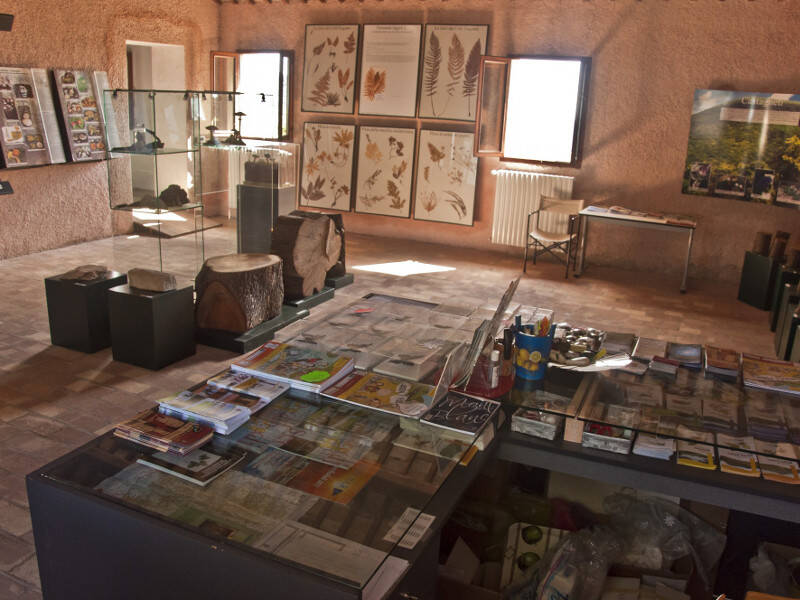
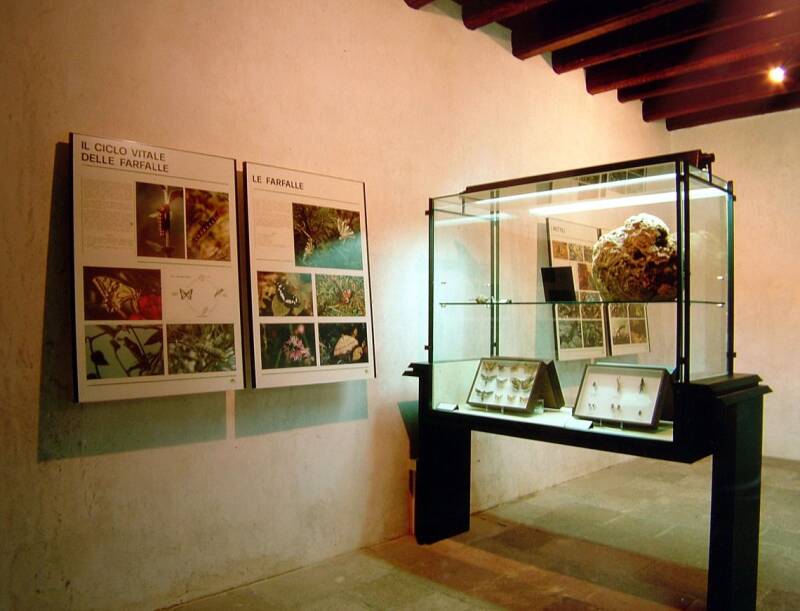
Currently some rooms of the villa are destined to house the provincial Naturalistic Museum, in whose rooms the vegetational and faunal aspects of the Euganean territory are illustrated.
Naturalistic Museum of the Euganean Hills
The Naturalistic Museum of the Euganean Hills in Baone is set up in the rooms on the ground floor of Villa Beatrice d’Este, on its right side with respect to the central hall: it is a small but significant museum that illustrates the environmental peculiarities of the Euganean Hills: flora, vegetation and fauna divided by environments. A place of science and history, but also of relaxation where you can spend a few hours with family, children, and friends discovering the many curiosities and beauties of the Paduan hills. All visitors can enjoy the environment surrounding the museum, combining a bit of healthy knowledge with a nice picnic, an excursion, some walks or a bike ride, perhaps refreshing themselves with typical local food and wine products.
Cultural and Educational Events
The Naturalistic Museum of Villa Beatrice d’Este organizes during the year a series of events, concerts, musical and literary shows through which to discover the exhibits and exhibitions. A dense program that also proposes educational activities and scientific dissemination in the territory, aimed at the education of younger generations, the enhancement of cultural and environmental heritage and the development of sociality. The internal spaces of the museum are set up to offer the best welcome with corners for reading and deepening the topics presented by the exhibitions, but also rooms for children where they can experiment and play to discover the contents in ways suitable for them. Outside Villa Beatrice d’Este, next to the park which still preserves intact a “maronaria” (chestnut grove) with trees over 400 years old, a picnic area has been created from which you can enjoy a 360° panorama of the Euganean Hills, spotting the location of Valle San Giorgio in the municipality of Baone, Mount Cinto, the ruins of what was the Monastery of the Olivetani on Mount Venda and the hermitage of Mount Rua. Villa Beatrice is also included in the itinerary that joins Mount Rusta to Mount Gemola in a pleasant walk of a couple of hours.
Conclusions
Importance of accommodation: Casa Luna presents itself as an ideal option for visitors to Villa Beatrice D'Este, offering a comfortable welcome and an atmosphere that reflects the beauty of the historical context.
FAQ:
-
Who was Beatrice d'Este? She was a noblewoman and Benedictine nun who founded a cloistered community on Mount Gemola in the 13th century.
-
What does the villa house today? The villa houses the provincial Natural History Museum, dedicated to the flora and fauna of the Euganean Hills.
-
Is it possible to have a picnic in the area? Yes, outside the villa there is a panoramic picnic area with a 360° view of the Euganean Hills.



"Do you want to delve into the history and secrets hidden behind the beauty of our territory? Download our free 10-page guide to plan your bespoke excursions and unlock the exclusive benefits of the Club Casa Luna."
Read our Pillar article:The Charm of Euganean History: Venetian Villas and Villages
Back to: Culture and surroundings
Aggiungi commento
Commenti