

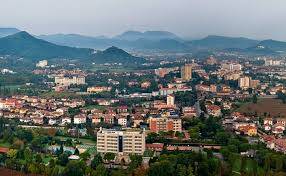
How many times have we wondered why a town, a hill, or a road is called a certain way? Place names, toponyms, are never accidental. They are true fragments of history, linguistics, geography, and culture, capable of telling millennia of events, settlements, human activities, and natural characteristics. The Euganean Hills, with their rich and complex history, are a true treasure chest of fascinating toponyms, each with its own story to reveal. Let's dive into a journey through time and words, to discover the hidden meaning behind some of the most emblematic names of our beloved Euganean Hills and the locations near Casa Luna.
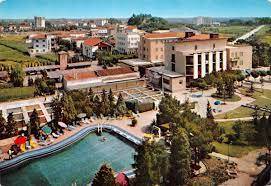
Montegrotto Terme: From Ancient Waters to Today.
Let's start from our home, Montegrotto Terme. Its name is a clear fusion of elements that define its identity:
-
Monte-: The prefix "Monte" is obviously linked to the presence of the nearby hilly reliefs, which characterize the landscape and offer a constant backdrop to the city.
-
-grotto: The "grotto" (or "Grotta") part probably refers to natural or artificial cavities, perhaps linked to the emergence of thermal waters or ancient structures such as mud caves. Some theories also suggest a link with the Latin term crypta, intended as an underground or hidden place.
-
Terme: This suffix, added in a more modern era, unequivocally emphasizes the thermal vocation of the locality, famous since Roman antiquity for its beneficial waters. Meaning: A "mountain with caves or cavities" linked to its "hot waters". A name that encapsulates the geological and therapeutic essence of the place.
Abano Terme: The Myth of the "Waters Without Evil".
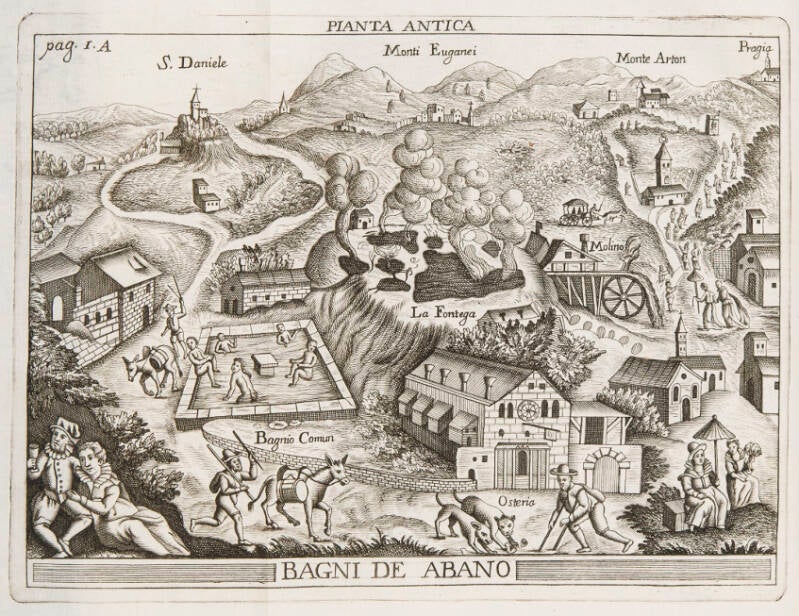
Not far from Montegrotto, we find Abano Terme, whose origin is shrouded in a veil of mystery and legend, but rich in charm. The name "Abano" probably derives from ancient Greek Áponos (Ἄπονος), which means "without pain" or "that takes away pain". This etymon is directly connected to the goddess Apona, protector of thermal waters and already venerated by the Romans. Her waters were considered miraculous, capable of alleviating all suffering. It is a direct and powerful reference to the curative properties of its famous thermal springs, the same that still attract visitors from all over the world today. Meaning: The "waters that cure pain", a name steeped in mythological history and therapeutic power.
Euganean Hills: The Legacy of an Ancient People.
The very name of our magnificent hilly archipelago, Euganei, has very deep roots and takes us back to a pre-Roman era. The "Euganei" were an ancient people who inhabited these lands before the arrival of the Veneti and then the Romans. They were considered the "indigenous" or "natives" of this region. The etymology of their name is uncertain, but some theories link it to the Greek eu-genés (εὐγενής), which means "well-born", "of good stock", or "noble", suggesting a distinct origin or a particular importance of this people. Meaning: The "hills of the noble people" or "of the well-born", a tribute to the first inhabitants of these lands.
Arquà Petrarca: The Village of the Poet.
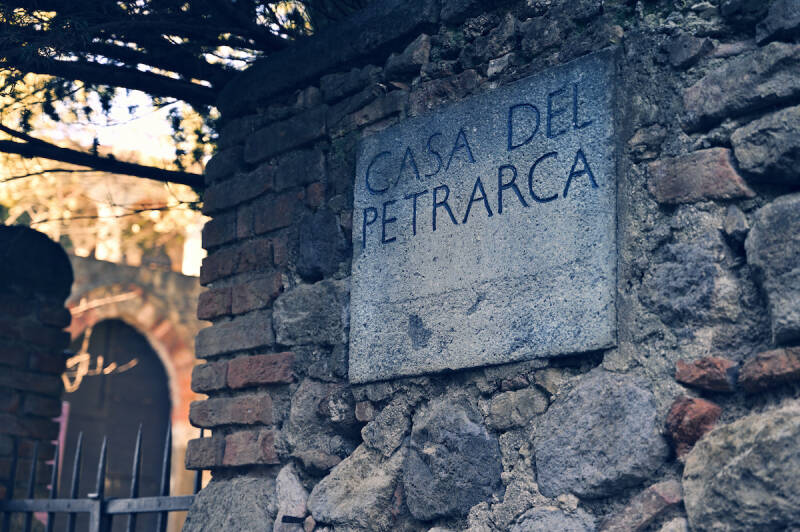
This enchanting village, one of the pearls of the Euganean Hills, bears a name that celebrates its most illustrious figure: Francesco Petrarch.
-
Arquà: The origin of "Arquà" is more uncertain. It could derive from the Latin Arquata, which means "arched", "curved", perhaps in reference to the shape of the hill on which the village stands, or to an ancient arched structure. Other theories link it to Arco-Aqua, for the presence of water.
-
Petrarca: The suffix "Petrarca" was added in 1870 in honor of the famous poet Francesco Petrarch, who spent the last years of his life here and died in 1374. His house is today a museum and a place of literary pilgrimage. Meaning: A village with an "arched" shape made immortal by the presence and memory of "Petrarch".
Monselice: Between Cliffs and Fortresses.
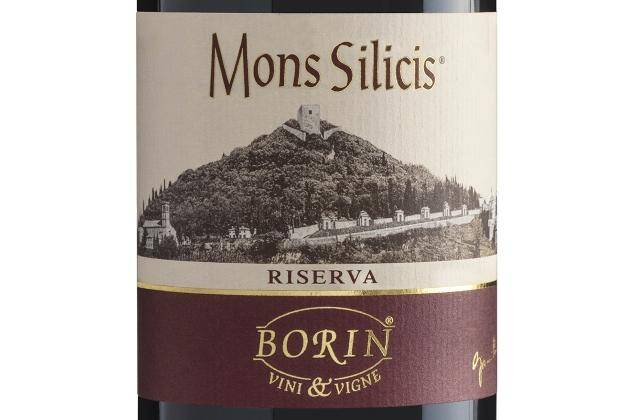
Monselice, with its imposing castle dominating the plain, has a name that evokes its robustness and strategic position. The name derives from the Latin Mons Silicis, which literally means "Mount of flint" or "Mount of stone". Flint is a hard and resistant rock. This clearly refers to the rocky nature of the hill on which the city is built and the availability of stone for construction, particularly of its walls and castle, which made it a fundamental defensive bulwark. Meaning: The "mountain of rock/flint", a name that perfectly describes its geological conformation and its defensive function.
Battaglia Terme: When Water Meets History.
The name Battaglia Terme is particularly evocative, suggesting an unusual mix of history and nature.
-
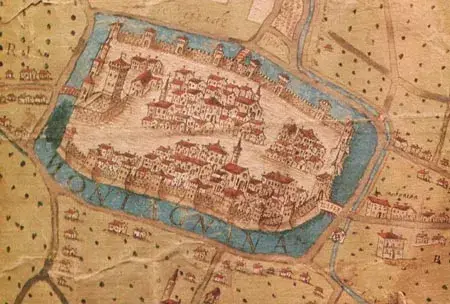
Battaglia: This element of the name is linked to a historical event, probably a battle or a clash that took place in medieval times near the village. Sources indicate various hypotheses, but the idea of a conflict is central.
-
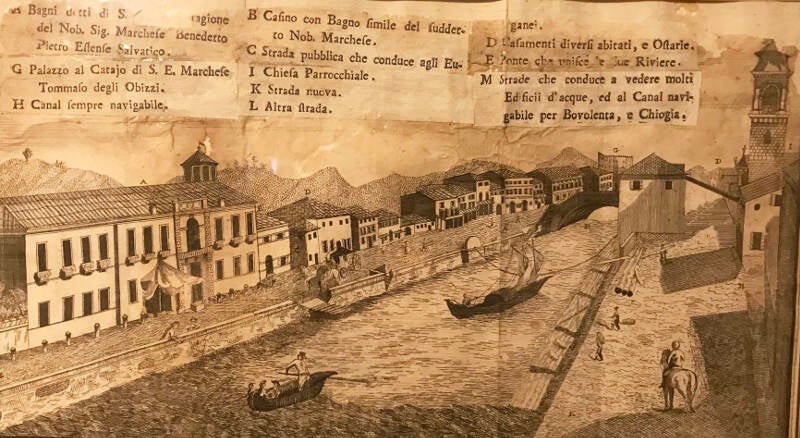
Terme: Here too, the suffix "Terme" was added in more recent times (in 1912) to emphasize the presence and importance of the thermal springs, which have a long tradition of exploitation, also for transport purposes through navigable canals. Meaning: The place of a "battle" enriched by its "thermal waters", a name that merges historical events and natural resources.
Montagnana: The City of the Walls.
Although not directly on the Hills, Montagnana is a nearby city closely linked to the area, famous for its intact medieval walls. The name "Montagnana" derives from the Latin Montaniana, which refers to a "mountainous" or "hilly place". This may seem curious given that the city is located on the plain. However, it is probable that the name originally referred to a small rise in the ground or a position that, although not a true mountain, was slightly elevated compared to the surrounding area, or perhaps to a viewpoint towards the mountains. Meaning: A "hilly" or "elevated" place, which today is famous for its imposing fortifications.
Conclusion: The Voice of the Places.
Each name tells a story, each toponym is a key to understanding the territory that surrounds us more deeply. In the Euganean Hills, these names speak to us of ancient peoples, battles and legends, extraordinary natural properties, and the deep connection between man and the environment. The next time you visit one of these places, or even just look at a map, try to rethink its name: you might discover a piece of history just waiting to be revealed. At Casa Luna, we will always be happy to share with you the wonders and secrets of our beautiful Euganean Hills!
"What is the place name that most intrigues you in the Euganean Hills? Leave a comment!"
❓ FAQ (Frequently Asked Questions)
-
Why are they called Euganean Hills? The name derives from the "Euganei," the ancient noble people who inhabited the region before the Romans.
-
What does Arquà mean? It probably derives from the Latin "Arquata" (arched), referring to the shape of the hill, or the presence of arches and water.
-
Why do many cities end with "Terme"? It is a suffix added to officially identify the localities that exploit the healing thermal waters of the subsoil.






"Do you want to delve into the history and secrets hidden behind the beauty of our territory? Download our free 10-page guide to plan your bespoke excursions and unlock the exclusive benefits of the Club Casa Luna."
Read our Pillar article: The Charm of Euganean History: Venetian Villas and Villages
Back to: "Culture and surroundings"
Aggiungi commento
Commenti